Tune in to our podcast series: The Dental Board Room
Listen Now

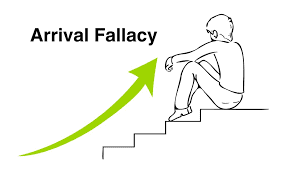
You've probably felt it.
You hit the number — the revenue goal, the paid-off loan, the second location, the whatever-it-was you'd been working toward for years. And for a moment, it felt the way you thought it would. Relief. Pride. The satisfaction of having done the hard thing.
And then, faster than you expected, something else moved into that space. Another target. Another ceiling to push through. Another milestone to reach before things would really feel the way you imagined.
This is not a personal failure. It's not evidence that you're ungrateful or incapable of contentment. It has a name.
It's called the arrival fallacy — and it is one of the most quietly destructive patterns in the lives of high-achieving dental practice owners.
In The 5 Types of Wealth, author Sahil Bloom describes the arrival fallacy this way: "The false assumption that reaching some achievement or goal will create durable feelings of satisfaction and contentment in our lives."
The assumption is almost universal. It's baked into the way ambitious people set goals. Once I pay off my student loans, I'll be able to breathe. Once the practice hits two million, I'll feel stable. Once I open the second location, I'll feel like I've made it. Once I hire the right team, things will finally calm down.
The arrival, when it comes, does produce something real. But the contentment doesn't last — because it was never really attached to the milestone. The milestone was a proxy for something deeper, something less easy to name, and the proxy can be reached without the underlying thing ever being addressed.
"I tend to be fairly aggressive in deferred gratification," says Wes Read, host of the Dental Boardroom podcast and founder of Practice CFO. "I can weather a lot. I have in my head this destination, that's where I want to be, and I will work incredibly hard to get there. But I have realized in some areas that when I get there, I lift my head and say — this actually isn't what I thought it was. I've been working really hard only to be up the wrong tree."
Up the wrong tree. Building toward a destination that was never quite what it looked like from the bottom.
The arrival fallacy isn't just about feeling let down by goals. It's about the operating system that produces those goals in the first place.
Most people — dentists included — inherit their definition of success. It comes from culture, from professional norms, from parents, from mentors, from whatever messages were transmitted during the years when identity was being formed. The scoreboard was handed to them: income, production, practice value, professional status. And they've been playing by those rules ever since.
Sahil Bloom calls what emerges from that process a default life — a life that isn't designed so much as accumulated. One where the practice consumes first, and everything else gets what remains.
"The opposite of a successful life is not a failed life," writes Bloom. "The opposite of a successful life is a default life."
Wes has made this point in his speaking engagements repeatedly: "If you don't author your life, there are thousands of people who will author it for you. They are clawing at your doorstep to get into your brain and dictate how you define success, how you define happiness, how you define joy."
The vendor pitching the equipment upgrade is authoring part of your practice. The industry metric that defines what a "successful" collection level looks like is authoring your target. The cultural narrative around productivity and busyness is authoring your relationship to time. If none of those inputs are filtered through a deliberate, self-defined framework for what a wealthy life looks like, the life that results is a default — assembled by external forces rather than designed by the person living it.
And when that default life produces the arrival fallacy — milestone reached, emptiness following — the instinct is to set a bigger goal. Aim higher. Push harder. The scoreboard is working fine; you just haven't scored enough yet.
That loop can run for a very long time.
Even when someone does step back and define what they actually want — builds the blueprint, designs the life, articulates the goals that would constitute genuine wealth across more dimensions than just the financial — there's still a second failure mode waiting.
It's called marginal thinking.
"Every human alive is guilty at some level of marginal thinking," says Wes. "And overcoming this is the definition, in some ways, of achieving success."
Marginal thinking is the belief that a single small neglect doesn't matter. That skipping the gym today has no real consequence. That missing the school recital this one time is fine. That not calling your father this week is no big deal — you'll call him next week.
It is almost never one decision. It is a pattern of individually harmless-seeming decisions that aggregate, over months and years, into an enormous cumulative cost.
"I don't need to go to the gym today. It's okay if I have this donut. It's okay if I miss this date night. It's okay if I don't read tonight with my eight-year-old son. It's okay to miss the dance recital of my daughter. It's just one time. No biggie," says Wes. "And it happens again. Maybe it happens three out of five times. Maybe it happens nine out of ten. In the aggregate, as the years go on, there's an aggregation of these marginal thoughts that prevent action. And therefore, the blueprinted plan doesn't get lift."
The blueprint was drawn. The architect finished the design. And then the construction never started, or started slowly and stalled, because each individual decision to not build felt reasonable in the moment.
Wes puts it plainly: "What prevents a blueprinted life from gaining traction — this disjointedness between thinking and doing — is marginal thinking."
The antidote to marginal thinking is not willpower. It's not motivation. It's not a productivity system.
It's understanding that small, consistent improvements compound — in the same way that marginal neglect compounds.
Wes tells the story of the British cycling team Team Sky, which had never won the Tour de France before a new coach arrived with a different philosophy. Rather than trying to make dramatic improvements in a few areas, the coach focused on improving everything by 1%. The cyclists' seats. Their tires. Their sleep quality. The pillows they used when they traveled. What they consumed during races. Every variable, improved slightly.
"Little changes," says Wes. "If you just changed 1% systematically over a period of time, that 1% change can dramatically change the direction or course of that thing you're pursuing."
Team Sky won multiple Tour de Frances in the years that followed.
The principle is the same one James Clear articulates in Atomic Habits: the aggregation of marginal gains. Small, consistent positive choices compound into outcomes that feel disproportionate to the individual effort.
This applies directly to the non-financial dimensions of wealth that most dental practice owners have been neglecting. You don't fix time poverty in one weekend. You don't rebuild a relationship with one long conversation. You don't reclaim physical health in a month of intense effort.
You do it by making a slightly better decision, consistently, in small increments — and trusting that the aggregation will do what aggregation does.
"Think of some of the worst-case scenarios of not going," says Wes — using gym attendance as the example. "Magnify the effect of not going." The marginal thought says it doesn't matter. The aggregate says it matters enormously. Train yourself to think in aggregate, and the small decisions start to make different sense.
The alternative to the arrival fallacy is not having fewer goals. It's redesigning how goals get set.
Stephen Covey's Seven Habits of Highly Effective People contains what Wes describes as one of the most useful principles in personal planning: begin with the end in mind. Define the destination clearly — not just the financial destination, but the full picture of what a wealthy life looks like across all five dimensions — and then reverse engineer backward into today.
"Define the end first," says Wes. "Start with the end in mind, and then reverse engineer back into today to say what do you do today in order to have that life?"
This is different from setting a revenue target and working backward into production goals. It's asking: what does my life look like at 75 — what relationships exist, what health have I maintained, what mental life do I have, how is my time structured — and what do I need to be doing today and this year to make that life probable?
The practice becomes a means to that end, not the end itself. Financial wealth becomes one instrument in a larger composition. And the arrival — when it comes — doesn't feel hollow, because what you arrived at was actually what you were building toward.
Wes closes the episode with three questions. Not to be answered quickly and moved past. To be held, considered, and returned to.
One: When was the last time you actually defined what wealth means to you — in your words, not anyone else's?
Not what the industry defines as a successful practice. Not what your income level implies you should want. What do you actually want your life to look like, in the dimensions that don't have a dollar sign?
Two: Which of the five types of wealth — time, social, mental, physical, financial — would score the lowest if you took an honest inventory today? And how long has that dimension been running low?
Three: What's the deliberate decision you've been putting off because the default is easier?
"What's your version of Sahil's cross-country move?" Wes asks. The author quit his hedge fund job and relocated his family across the country to be closer to the people who mattered most. Not everyone needs to make a decision of that magnitude. But most people have a version of it — the thing they know would meaningfully change the trajectory of their non-financial life, if they actually did it.
What is yours?
The arrival fallacy loses its power when the destination is actually right.
Most dental practice owners haven't asked the underlying question — what would constitute a genuinely wealthy life across all five dimensions — in any serious, deliberate way. The practice demanded attention. The financial goals were clear and motivating. The other things got left for later.
Later has a way of arriving faster than expected.
"What gets measured gets managed," says Wes. "How much do I measure in my personal life? How much of those ingredients that produce happiness in life — how much do I measure those?"
The scorecard exists. It has five columns, not one. Start filling it in.
And when you run that audit honestly — when you see where the real gaps are, not just the financial ones — you'll find that the next goal you set looks very different from the last one.
That's not a smaller ambition. That's a better one.
Listen to Episode 157 of The Dental Boardroom Podcast: https://podcasts.apple.com/us/podcast/157-30-dinners-left-why-money-isnt-wealth/id1518344747?i=1000766303144



Wes knows what's best for dental practices. He's been doing this for a long time and he sees lots of practices. He can tell me how our practice is doing, and what we can do to increase our productivity. With past CPA's, there were no ideas. It was all coming from me, saying "I think I can do better, but I don't know how." I come in to meet with Wes and he says "You CAN do better, and I know how."
PracticeCFO is in hundreds of dental offices around the country. They know what numbers should look like. They know what percentages of payroll, rent and supplies should be, and they will hold you accountable to those numbers, which will really help you stick to your plan and your path of growth and savings. That is invaluable
Whenever something comes up, whether it's building or practice related and we weren't sure where the numbers would go, PracticeCFO has been instrumental in helping us figure that out. I can't say enough of how important that is - that it goes beyond that initial partnership. They make sure this business marriage works.
When I go home from work, I don't spend a whole lot of time stressing about what my books look like, or how much I owe in taxes. By using PracticeCFO, the burden of keeping track of a lot of the big financial numbers and metrics are taken off my plate.
PracticeCFO helped me develop a plan for the future. I have colleagues that work with other accountants that don't have a plan - they just look at the numbers of the practice and that's it. There's no plan for 10, 20 years from now. But with PracticeCFO, you get that. PracticeCFO makes you feel like you're they're only client.
(In reference to his practice sale) What could've been super stressful, wasn't! When picking John and Wes, it was from word of mouth recommendations and other people's experiences from the past that really did it for me. And it turns out that those recommendations were right on the line.
Wes knows the business side of dentistry. His comprehensive plan will organize your personal and professional finances so you can focus on taking care of patients. Massive ROI.
I can’t say enough good things about everyone at PracticeCFO. Everyone on the team is professional, organized, knowledgeable, helpful and kind. They also respond to emails and phone calls immediately and are always happy to help. They have helped me navigate year-to-year as a business owner. PracticeCFO gives me peace of mind that my business is in good hands.
I love Practice CFO! They have helped me obtain a practice and maintain a practice. They are incredible people who are on top of everything and make owning and running the business portion of a practice easy. They couldn’t be better for my business and my sanity. They have every detail of the business and taxes taken care of where all I have to do is show up and follow their easy steps to success!
Practice CFO has the best tools I’ve seen for personal tax and financial planning in addition to top-tier corporate tax and accounting services. I have been very pleased with the level of quality service. They manage my monthly bookkeeping and accounts payable. It is a great system and saves me a ton of time, and it allows us to have monthly financial statements within a week of month end.

This will close in 0 seconds